
Federal BOP Release Scope
The Federal Bureau of Prisons manages federal sentenced custody. Its locator is the right tool after a person has entered BOP custody following a federal sentence. It is not the general locator for federal pretrial prisoners held for the U.S. Marshals Service, and it does not cover civil immigration detention. It also says nothing by itself about a separate Utah case or county booking.
No physical BOP prison was identified in Uintah County through the reviewed official sources. That is a local location finding, not proof that no Uintah resident or Uintah-connected defendant is in BOP custody elsewhere. Federal prisoners can be placed throughout the national system. Search the person, not the county. Use the federal docket to establish the case and sentence, then use BOP to identify custody and release information within BOP’s authority.
| Custody question | Correct authority |
|---|---|
| Federal sentenced prisoner | BOP Inmate Locator and BOP records |
| Federal pretrial prisoner | Federal court, USMS, and holding facility |
| Civil immigration detention | ICE ODLS and ERO |
| Utah state prisoner | UDC and Utah Board |
| Uintah jail detainee | Uintah County Jail and Sheriff records |
Federal BOP Release Search
The BOP Inmate Locator supports number and name searches. The strongest route uses a BOP register number. The interface also accepts DCDC, FBI, or INS numbers. A name search can be narrowed with optional age, race, and sex fields. Those filters help separate people with similar names, but the matched identifiers still need careful comparison.
- Search by a known federal number whenever possible.
- If no number is available, enter the full name and useful optional filters.
- Compare the register number, age, race, and sex before relying on a result.
- Read the Release Date and Location together, not as isolated labels.
- Save the result date and consult BOP’s record explanation for the label’s meaning.
BOP results include name, register number, age, race, sex, Release Date, and Location. A future release date is projected and can change. A past date paired with no institution supports the conclusion that the person left BOP custody on that date. BOP also warns that First Step Act recalculations can affect the currency of projected dates. Never convert a projected field into a guaranteed exit.
Read Federal BOP Release Results
The BOP records explanation gives the necessary context for a released result. A past Release Date with no facility means the person is no longer in BOP custody. The statement does not mean the person has no federal supervised release, no pending matter, and no custody under state, local, immigration, or another federal authority. Keep the claim tied to BOP.
The source also notes that a displayed “Date Released” can include a death event. That is another reason to avoid assuming every past date describes a routine return to the community. Check the federal docket and, when needed, seek the underlying federal record. A projected future date can shift because of sentence computation or other lawful changes. Record the date on which the locator was checked.
The official explanation was captured from the BOP source so the release label can be read in its proper authority-specific context.
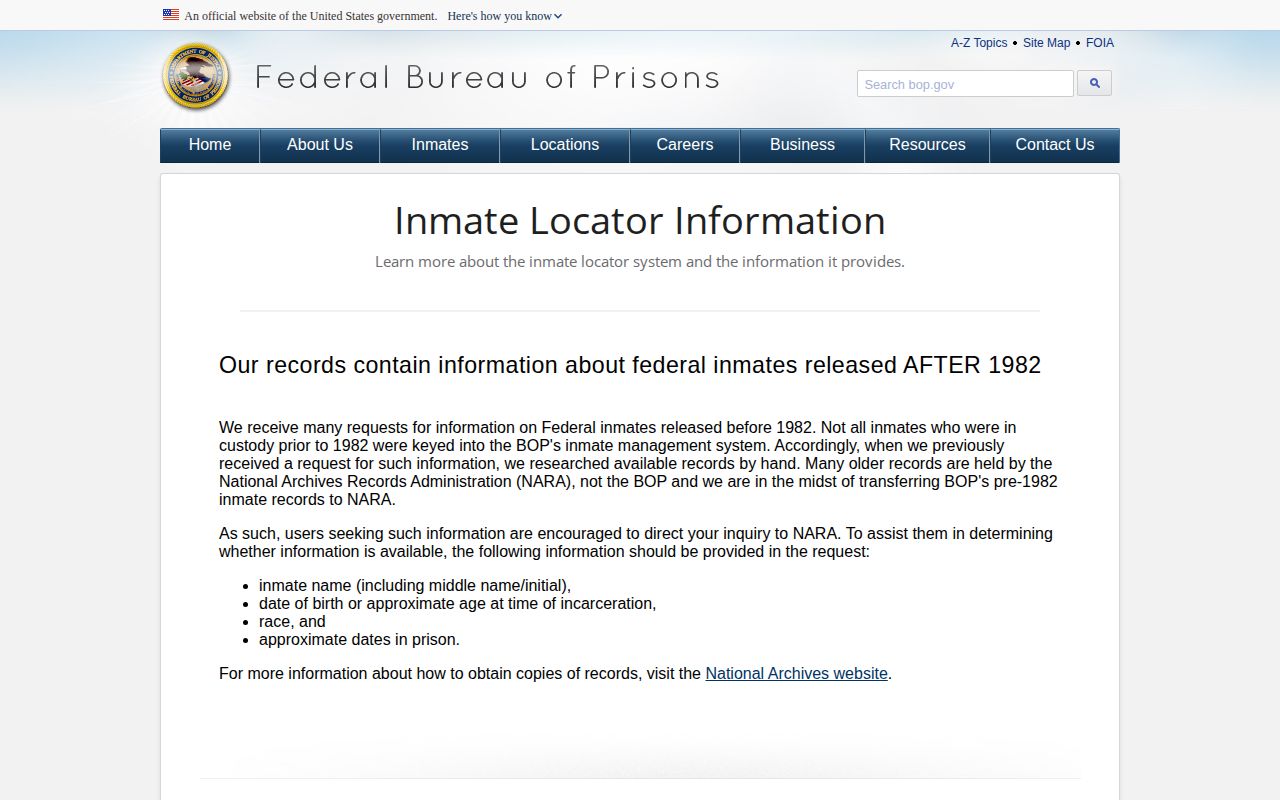
The image supports the distinction between departure from BOP custody and a broader claim about all custody or supervision.
Federal BOP Release Records
The locator is an efficient public index, not a certified full custody history. When exact documentation matters, identify the federal defendant by register number, case number, and sentencing court. Ask for the specific existing record needed, such as the sentence computation, release date record, institution history, or another releasable custody document. Do not ask BOP to decide whether the person is free from every authority.
The federal court docket supplies the legal record. It can show judgment, sentence, later orders, and conditions of supervised release. That docket does not necessarily prove the exact gate time at a BOP institution. Conversely, a BOP release date does not replace the court judgment or explain all later supervision. Use both sources when the legal basis and physical custody event matter.
- Release Date
- The BOP result field for a past or projected exit from BOP custody.
- Register number
- The federal prisoner identifier used for a precise locator search.
- Supervised release
- A court-ordered period of federal supervision after imprisonment.
- Authority-limited
- A result that establishes status only within the agency reporting it.
Note: Preserve the BOP result and the federal docket date together when a durable timeline is needed.
BOP Versus USMS Release Records
The U.S. Marshals Service generally manages federal pretrial detention and transports prisoners between courts and facilities. It uses federal, state, local, and private holding sites. A person may never appear as a sentenced BOP prisoner if the federal case ends before BOP commitment. In that situation, an unsuccessful BOP search is expected and provides no release answer.
Use the federal court order and the holding facility to confirm pretrial release. USMS has no public released-person locator and states that it does not make prisoner personal histories, photographs, or arrival and departure times publicly available through a simple lookup. A properly framed USMS Freedom of Information Act request may be used for agency records, subject to federal exemptions. The U.S. Marshals detention page sets out that separate chain.
Once a sentenced person is delivered to BOP, the locator becomes relevant. Keep the transition point visible. A USMS movement to BOP is continued federal custody, not community release. Likewise, a BOP exit followed by another authority’s hold must be described as a transfer or new custody event if the record supports it.
Federal Release and Supervision
Federal supervised release is set by the federal court and follows imprisonment when ordered. It is not Utah parole and is not managed by UDC Adult Probation and Parole. A BOP result may correctly say the person is no longer in BOP custody while federal court supervision continues. The federal docket and probation channels, not the BOP location field alone, establish those conditions.
This distinction also affects terminology. “Release from BOP” means the federal prison agency no longer holds the person. “Release from federal supervision” is a later or different legal event. A state parole result applies only to a Utah sentence. If the same person has more than one case, build separate timelines and identify each authority’s start and end event.
For a Uintah-connected search, the Uintah County custody crosswalk helps identify which system to use. A county arrest does not become a BOP matter without a federal case and sentence. A federal BOP result does not explain what the Uintah County Jail did on a separate booking.
Federal BOP Contact Route
The BOP system is national, and no prison in Uintah County was identified. Therefore no local BOP facility address, phone, or release desk can be truthfully listed. Start with the official locator and the facility named in the matched result. For past custody, use BOP records and the sentencing court rather than calling Uintah County Jail.
Federal Bureau of PrisonsNational sentenced-custody system
Official inmate information channels
BOP Inmate Locator
If the locator returns a current institution, follow the official facility link and its published contact details. If it returns a past release date and no institution, use the records explanation and federal docket. If it returns no match, check spelling and identifiers, then determine whether the person was held by USMS, ICE, Utah, a county, or another jurisdiction.
No local address is better than a false one. Federal authority and actual placement control the contact route.
Confirm a Federal BOP Release
A reliable federal release finding has a clear scope. The matched BOP record identifies the person. The Release Date and Location show the BOP status. The BOP explanation defines the label. The federal court docket supplies the sentence and later supervision orders. When necessary, a BOP record request adds official custody documentation.
Conflicts often reflect timing or multiple authorities. A future date may change. A past BOP date can coexist with supervised release. Another agency can take custody. A person in federal pretrial detention may have no BOP record. Resolve these points rather than choosing whichever screen seems most conclusive.
Use exact language in notes: “released from BOP custody,” “projected BOP release date,” or “not located in BOP on the date searched.” Those phrases remain faithful to the official record and leave room for the separate county, state, USMS, and ICE checks that an individual case may require.