
Uintah County Release Records Explained
A release is a recorded end to one custody episode. It does not always mean that the person walked into the community. The Uintah County Jail may record a bond release, a court-ordered release, time served, sentence completion, or a transfer to another authority. A person sentenced to Utah state prison moves into Utah Department of Corrections custody. A federal or immigration hold can also continue confinement after the county booking ends.
Three events should be kept apart. A court can authorize release. The jail must then clear holds and finish its own process. Finally, the facility records the actual exit or transfer. A court entry proves what the judge ordered, while the jail custody event proves what happened at the facility. Utah VINE may send a fast alert, but it is a notice rather than a certified release record.
Uintah County Inmate Release Types
The recorded disposition controls the next search. County and state systems use different terms, and a transfer must not be rewritten as a community release. Ask for the agency's existing label and destination instead of asking staff to create a new explanation.
| Recorded event | What it can mean | Best next record |
|---|---|---|
| Bond or court order | Release was authorized, subject to other holds and jail processing. | Jail release event plus the court docket. |
| Time served or sentence end | A definite county sentence ended after applicable credit. | Judgment, jail calculation, and actual exit record. |
| Parole | A state prisoner left prison but remains under UDC supervision. | Board order, UDC movement record, and AP&P status. |
| Probation | A court placed the person under community supervision, sometimes after jail. | Court judgment and current UDC/AP&P status. |
| Transfer | County custody ended because another jail, UDC, USMS, or ICE took custody. | County destination field and receiving authority's record. |
| Dismissal | The case may no longer support custody, though another hold may remain. | Court disposition and jail confirmation. |
- Discharge
- The end of the sentence or supervision, not merely release from a prison building.
- Time served
- A sentence satisfied by time already spent in custody.
- Detainer
- A request or hold tied to another authority that can delay or redirect release.
- Expungement
- A legal process that seals qualifying government records from ordinary public access.
Uintah County Release Record Fields
The most useful county record is the executed custody event. Uintah County has not published a web field schema, so these are fields to request if the Sheriff's existing system maintains them. Production and public classification are not guaranteed.
| Field to request | What it shows |
|---|---|
| Identity and booking number | Connects the event to the correct person and booking episode. |
| Booking date and time | Marks the start of that county custody episode. |
| Actual release date and time | Records when the jail processed the exit or handoff. |
| Release disposition or type | Preserves the agency's reason or event label. |
| Receiving destination or authority | Distinguishes community release from continued custody elsewhere. |
| Order or authorization reference | May connect the jail action to a court or other authority. |
A booking photo is a separate issue. Utah law generally protects a jail booking image unless a conviction-based or another listed exception applies. Release by itself does not make the image public. A request can ask for the photo, but the Sheriff may deny or redact it under current classification law.
Note: Request each field only if maintained, and expect the Sheriff to apply classification and redaction rules to the responsive record.
Request Uintah County Release Records
The official written route is the Uintah County Sheriff GRAMA form. A narrow request should identify the person, the approximate booking episode, and the existing records sought. Utah's Government Records Access and Management Act is commonly called GRAMA.
- Give the person's name and a useful identifier, such as date of birth or booking number, if known.
- State the approximate booking date and the exact release or transfer fields requested.
- Ask for an electronic copy and a cost estimate before work exceeds a limit you choose.
- Send the form through the county channel and preserve any written response, denial, or referral.
- If the Sheriff identifies another record holder, direct the next request to that agency.
Questions: 435-781-5409
Email: thanberg@uintah.utah.gov
County guidance: charges depend on preparation time, payment precedes release of records, and a response is generally due within ten business days.
The county forms page shows the official records and property channels.
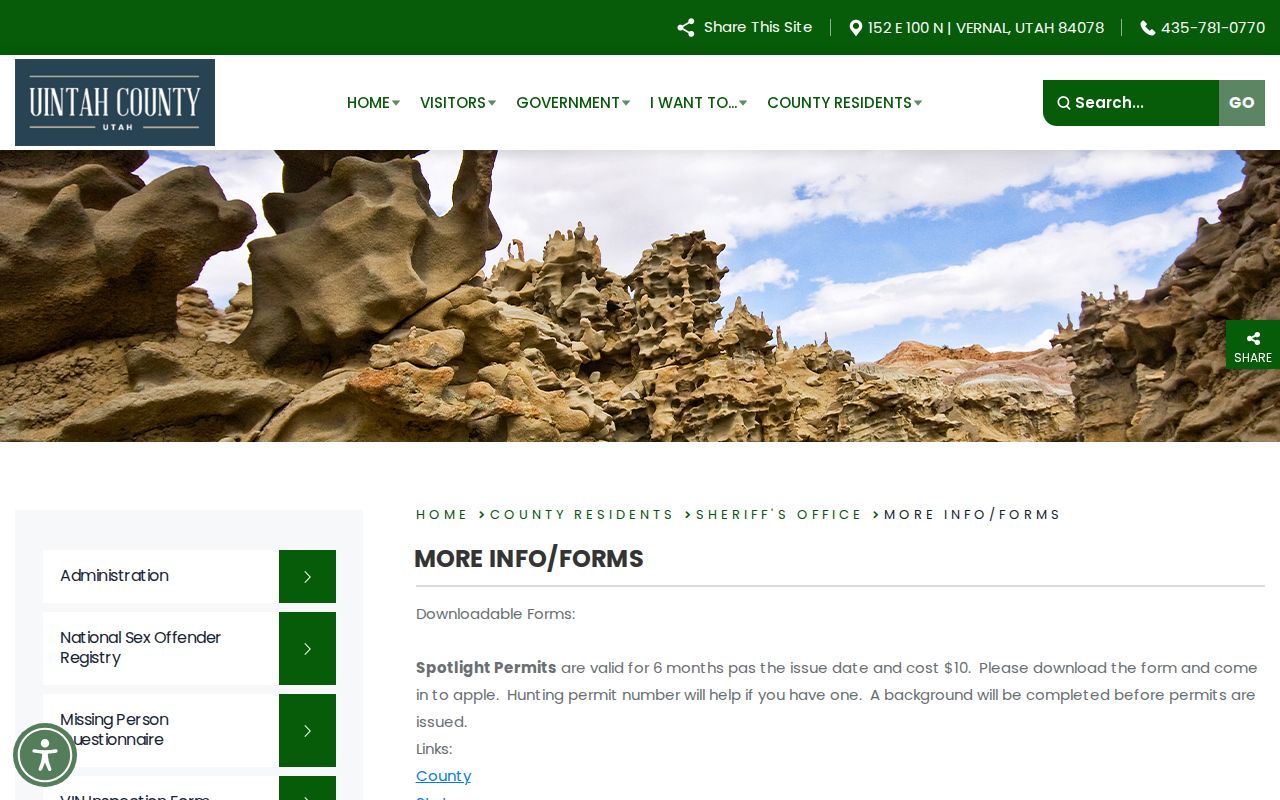
The page supports a direct county request when no online roster or release archive exists.
Wording matters. Ask for public portions of an existing booking and custody-event record rather than asking staff to research why someone left. A useful request lists the booking identifier, booking date and time, actual release or transfer time, recorded disposition, and receiving agency if maintained. If the date is uncertain, give a narrow range. The Sheriff may redact protected material, charge its actual preparation cost, or say that a requested field is not maintained. Each response helps locate the proper record holder.
Utah Release Record Access Rules
GRAMA section 63G-2-201 presumes a record public unless another law classifies it otherwise and permits free inspection of public records during normal hours. Private, controlled, protected, sealed, expunged, juvenile, and other restricted material remains outside that rule. Section 63G-2-204 requires a reasonably specific request to the entity that keeps the record. The entity may grant access, deny it, identify a likely holder, or invoke extraordinary circumstances.
Section 63G-2-203 allows reasonable actual-cost fees under approved policy. A denial must describe what was withheld, cite the legal basis, and explain the administrative appeal. If an agency record about an individual is inaccurate, section 63G-2-603 provides a correction route in many cases, but court files follow the clerk and court process.
Note: A GRAMA response can redirect the request to the likely record holder when Uintah County does not maintain the requested item.
Find Uintah County Released Inmates
Start with the last known authority. One search cannot cover county jail, Utah prison, federal sentencing, federal pretrial detention, and immigration custody. The following sequence keeps those systems separate and creates a useful timeline.
- For a recent county case, call the Uintah County Jail at 435-781-1300 and ask whether the person is confined, released, or transferred.
- Search the matched person in VINELink for a custody-change event, then verify the wording with the facility.
- Use Utah Xchange or the appropriate court clerk to find the order, disposition, judgment, or sentence.
- For state custody or current supervision, use the official UDC search and Board decisions.
- For federal sentenced custody, use BOP. For an immigration transfer, use the jail destination record and ICE ODLS.
- When a public interface cannot settle the event, request the executed release, movement, or termination record.
A person who left prison on parole can remain in UDC's search because parole is still state supervision. A person whose sentence fully terminated may no longer appear. In both cases, a no-match is not a discharge certificate.
Identity should be checked at every step. A common name can point to the wrong person, while spelling variants can hide the right record. Compare a date of birth, booking number, UDC number, court case number, BOP register number, or immigration A-number when the official interface permits it. Record the exact status phrase and event date. Do not turn “transferred,” “paroled,” or “not in BOP custody” into a broader claim than the issuing authority made.
Utah Search for Uintah Releases
The UDC Offender Search covers only people currently under Utah Department of Corrections supervision. It can help with a Uintah County case that led to state prison, parole, or UDC probation. It does not cover an unsentenced county detainee, and the official page does not promise a historical released or discharged result.
| Available route | Use it for | Important limit |
|---|---|---|
| UDC Offender Search | Current inmates, parolees, and probationers under UDC. | Not a full discharge archive or county pretrial roster. |
| Board decision search | A written parole, rehearing, rescission, or termination action. | A future parole date is not proof of actual exit. |
| UDC GRAMA or staff inquiry | Movement, actual parole release, termination, or expiration records. | Disclosure and classification rules apply. |
| AP&P Region 6 | Verification of current local supervision where disclosure is permitted. | It does not prove the jail's exact release time. |
The official UDC material does not document a public projected-release-date field, historical release reason, completed custody timeline, supervising agent, or photograph. Do not assume those fields appear. For a future state-prison date, read the actual Board order and then confirm implementation through UDC movement status and VINE.
Note: Current UDC supervision and completed sentence discharge are distinct events, so each requires the record that documents that stage.
Uintah Release Orders and Jail Events
Vernal Justice Court and the Uintah County Jail share the Public Safety Complex address, but they prove different facts. The justice court handles class B and C misdemeanors, ordinances, infractions, and much traffic work. Felonies and class A misdemeanors are district court matters. Search both levels in Xchange when the charge level is uncertain.
A docket can show bond, dismissal, a sentence, credit for time served, probation, or commitment to UDC. It cannot prove the time the jail opened the door or transferred the person. Another case, warrant, or hold may keep custody in place after one court order. Build a short timeline with the order, the jail event, and any VINE alert instead of treating “case closed” as physical release.
Uintah Pretrial Release Infrastructure
Uintah has a local release-related development that is distinct from the jail's custody record. The Utah Commission on Criminal and Juvenile Justice documented a Uintah County Pretrial Services Program and the October 2024 opening of a Criminal Justice Services Office, along with jail and testing programs. State grant guidance says pretrial services help courts make informed release decisions and supervise conditional release before a case ends.
The 2024 CCJJ report documents the local program.
This program concerns court decision support and conditional supervision. The research does not establish individual eligibility, a public intake route, or automatic release, so the jail event still must be confirmed.
Uintah Post-Release Support
Uintah County links Northeastern Counseling Center, which describes counseling, addiction treatment, and emergency mental-health support for Uintah, Duchesne, and Daggett counties. Its Vernal number is 435-789-6300. This is a regional navigation option after release, not proof of a formal jail partnership, an automatic referral, or eligibility for any specific service.
Post-release supervision is separate. UDC Adult Probation and Parole Region 6 serves Daggett and Uintah counties from Vernal. Probation is ordered by a court; parole is release from state prison under Board authority. Current supervision can be checked through UDC and, where appropriate, confirmed with AP&P.
Note: Northeastern Counseling Center is a regional service option, not a documented automatic referral from the jail or AP&P.
Property After a Uintah Release
Uintah County publishes distinct forms for nonweapon and firearm property. Firearm release may require an ATF trace plus approval from the arresting officer and County Attorney. The county material also says evidence property is held until 30 days after sentencing, although a form can be filed earlier.
These are evidence and property-unit rules. They are not a verified description of routine personal belongings returned at the jail door. Ask the Sheriff which process applies to the item. A disputed agency record is also different from an expungement request: correction addresses inaccurate data, while expungement seals a qualifying record through a legal process.
Uintah Release or ICE Transfer
A county booking can end in an ICE transfer rather than community release. No current Uintah ICE facility listing or local detention contract was confirmed in the reviewed official sources, but that negative finding cannot rule out a person-specific detainer. Ask the jail for the recorded destination before describing the event.
ICE explains that a detainer can request notice and custody for up to 48 hours beyond the normal release point so ICE can assume custody. ICE's Online Detainee Locator covers current detainees and some people released from ICE custody within about 60 days. That recent-release window concerns ICE custody, not the earlier Uintah County booking.
Federal sentenced custody follows another route. The BOP Inmate Locator can show a Release Date and Location. BOP explains that a past date with no institution supports departure from BOP custody, but it does not rule out state custody or federal supervision. Federal pretrial prisoners are generally handled through the U.S. Marshals Service network. USMS has no public released-person locator, so the federal docket, the known holding facility, and an appropriately framed FOIA request are the practical sources.
Expunged Uintah Release Records
Beginning January 1, 2026, Utah courts identify qualifying automatic-expungement cases. An expunged case is removed from ordinary public Xchange access, while the subject's My Court Case account may display “Case Expunged.” A blank public result therefore cannot distinguish no case from a sealed, expunged, juvenile, or otherwise nonpublic matter.
Expungement seals government records but does not automatically erase copies that were previously held outside government. Do not reconstruct restricted information from an old private copy. The person who is the subject of the case may have limited routes to obtain an order or personal history through the Utah Courts process.
Note: A blank court search can reflect sealing, expungement, juvenile confidentiality, system coverage, or identity mismatch rather than a release event.
Compare Uintah Release Search Paths
Match the record to the last authority. Each system answers one part of the custody history, and none should be stretched beyond its published scope.
| Situation | First official route | What confirms release |
|---|---|---|
| Uintah County Jail booking | Jail phone, VINE, and court docket | Sheriff release or transfer record |
| Utah state prison | UDC search and Board decisions | UDC movement record; termination record for full discharge |
| Federal sentenced custody | BOP Inmate Locator | Past BOP Release Date and records explanation |
| Federal pretrial custody | Federal docket and holding facility | Court order, facility record, or appropriate USMS FOIA |
| Immigration custody | County destination and ICE ODLS | ICE status or release record, with ERO follow-up if needed |
Q: Why did the person vanish from a search? A county feed does not exist, UDC stops covering a person after full supervision ends, and sealed records leave Xchange. Absence alone does not identify which reason applies.
Uintah County Release Facilities
The facility map includes the local adult jail, a regional juvenile center, Utah's two state prisons, and authority-specific federal systems that can serve a Uintah case. A person is searched through the system that held them, not merely through the county where the case began.
- Uintah County Jail: county booking releases and transfers are confirmed by the Sheriff.
- Split Mountain Youth Center: juvenile confidentiality requires authorized juvenile-justice channels.
- Utah State Correctional Facility and Central Utah Correctional Facility: UDC and Board records control.
- Federal Bureau of Prisons System: BOP covers sentenced federal custody.
- ICE Detention System: ODLS and ERO cover immigration custody.
- U.S. Marshals Service network: the federal docket, holding facility, and FOIA are the main routes.
Utah prison placement is based on UDC classification, not the county of conviction. No physical BOP prison or current ICE facility was identified in Uintah County.