
Uintah County VINE Coverage
Utah VINE is a free, continuous automated service for offender custody information and notifications. Utah public-safety material says it covers offenders in Utah prisons and jails. That makes it a useful one-person channel when someone may have been held at Uintah County Jail or entered Utah Department of Corrections custody. It is especially useful locally because Uintah County publishes no official current roster or recent-release feed.
Coverage does not turn VINE into a complete custody history. Data comes from participating agencies. A current event may lag, and older episodes may not remain available as an archive. UDC also warns against relying on VINE alone. Use the notification as a prompt to contact the holding or releasing agency and request its operational record when exact timing or destination matters.
The Utah offender registry is also separate. It can remain visible for a qualifying registrant after custody ends and may publish details required by statute. Registry status is not custody status, however, and the registry does not state when every person left jail or prison. VINE should be read as a custody-notification source, while the registry serves its narrow offense-based purpose.
VINE does not replace federal tools. A federal sentenced prisoner belongs in the BOP Inmate Locator. Federal pretrial custody may require the federal docket, holding facility, or USMS records path. ICE has its own detainee locator. A failed Utah VINE search cannot exclude those systems.
Search Uintah Inmates on VINE
Begin at the official VINELink state-selection page. Search one person, not a generic county window. The result must be tied to the correct identity before an alert is registered. A common name can produce several records, and attaching notifications to the wrong person creates a false custody timeline.
- Open VINELink and choose Utah from the state selection.
- Select the offender search offered by the current interface.
- Enter the available name or identifier for the specific person.
- Compare identity and custody details before opening a matched record.
- Read the status, facility, date, and event language exactly as displayed.
If several matches appear, compare every nonrestricted identifier the service provides. Do not rely on name alone. If no result appears, check spelling and the identification number, then consider authority and scope. The person may be in a federal system, fully outside the current data, or affected by an agency upload delay. For a Uintah jail case, call 435-781-1300 rather than treating no result as release.
The matched official interface is shown below through its manifest source.
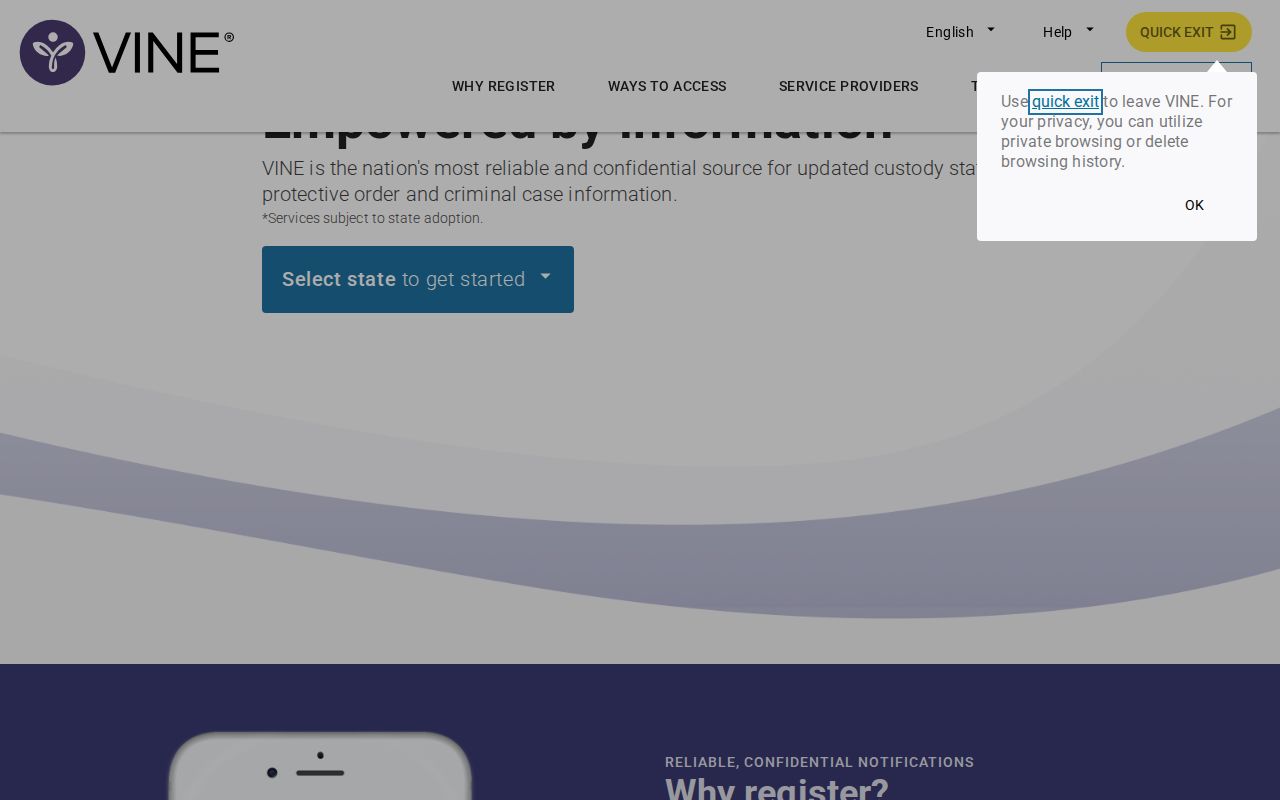
The captured state-selection and person-search route is the entry point. The individual result, not a county-wide search, is where custody events and notification options belong.
Read Uintah VINE Release Results
A VINE result should be described only with the fields and event wording it actually shows. Utah source material supports custody status and notification events such as release, transfer, escape, and death. UDC documents additional state-prison events. It does not justify turning every event into “released,” nor does it make VINE a certified document.
| Result item | How to interpret it |
|---|---|
| Matched name or identifier | Connects the result to one person; compare carefully before relying on it. |
| Custody status | Reports the agency-supplied status at the time shown. |
| Facility or location | May identify the current holder or the site connected to an event. |
| Release event and date | Signals a reported release but still needs facility confirmation for a certified record. |
| Transfer or movement event | Means custody may continue at another jail, prison, or correctional center. |
| Future parole-date notice | Reports a prospective UDC parole date, not the completed gate event. |
A Uintah County jail release and a Utah state-prison parole are different events. The county jail record can show how the booking ended. A person released from prison onto parole remains under UDC supervision, so the person may continue to appear in the UDC Offender Search. Full sentence termination is a later discharge and may require a UDC termination or expiration record.
Note: Preserve the exact event phrase and timestamp because “release,” “transfer,” and “parole date” answer different custody questions.
Register Uintah Release Notifications
Registration must attach to the correctly matched person. The current interface may offer phone, email, text, app, or other channels. Choose only methods displayed for that record. Utah guidance gives specific steps for telephone acknowledgment, including a four-digit PIN. The PIN confirms receipt and stops repeat calls; it is not an inmate identifier.
- Open the matched person’s record after confirming identity.
- Select the release or custody-event notifications offered on that record.
- Choose a reachable direct phone number or another available delivery method.
- For phone alerts, create a memorable four-digit PIN and keep it secure.
- When a call arrives, listen to the event and enter the PIN to acknowledge it.
- For email or other channels, complete the confirmation shown by the interface.
Calls can occur overnight. Utah’s brochure says unacknowledged calls may continue for up to 48 hours, and multiple numbers can share a PIN. Do not use a switchboard that cannot route the automated call and PIN response. If the PIN is forgotten, the published instructions direct callers to the VINE number and the operator option. The enrollment and help number is 1-877-884-8463.
An alert should start a verification step. Contact the jail for a county event or UDC for a state-prison movement. If a written record is needed, request the release, movement, or transfer record from the agency that created it. VINE is designed for prompt notice, not archival certification.
Phone registration is anonymous under the published Utah guidance. Still, use a number that can receive automated calls and allow the recipient to enter the PIN. Email registration should follow the live confirmation steps. Do not assume the phone PIN applies to email unless the interface says so. Delivery settings can change, so the choices shown on the matched record control.
Utah VINE Movement Alerts
Utah adds a distinctive state-prison layer to ordinary jail notifications. UDC lists prison release, escape and return, death, and a parole-release-date notice 30 days in advance. It also lists moves to county jails, transfers between the Salt Lake City and Gunnison prison sites, and moves involving community correctional centers. These details matter for a Uintah County search because a local booking may end in a state transfer, and a Uintah-origin state prisoner can be placed outside the county.
The richer event set is helpful only when each label is kept in context. A 30-day parole-date notice is prospective. The Board’s date can change, and a rescission process can remove a granted date before exit. A transfer between UDC sites is continued custody. A move to a county jail may reflect another proceeding or placement. None should be recast as release to the community.
Since Uintah County has no official roster, a movement alert can explain why direct county information changed or why a person is no longer at the expected site. Follow the chain. Ask the prior holder whether a transfer occurred, identify the receiving authority, and then use that authority’s record. This approach turns a fast alert into a verified custody timeline without asking VINE to prove more than it reports.
Confirm Uintah VINE Release Events
The strongest source for an exact physical release is the responsible facility’s executed release or movement record. For Uintah County Jail, call the jail and submit a narrow Sheriff GRAMA request if a written record is needed. Ask for the actual release or transfer time, disposition, and destination if maintained. A court order can explain authorization but not the final door time.
For a state prisoner, read the Utah Board of Pardons and Parole decision and then confirm implementation through UDC movement or legal-status records. A person on parole remains supervised by UDC Adult Probation and Parole. The UDC public search covers only people currently under supervision and is not a historical discharge locator. The Uintah County released inmate search path separates county release, state parole, and federal custody when the correct authority is unclear.
Contradictions often reflect timing rather than a bad source. A judge may enter an order before jail processing. VINE may report a transfer before the receiving system updates. UDC may still show parole after prison release because supervision continues. Build a short timeline using source, exact event text, and timestamp, then contact the last known holder.
For a Sheriff record request, identify the person, approximate booking episode, and the exact custody event sought. Ask for the public parts of the actual release or transfer record rather than asking staff to certify that the person is free. If the agency denies part of the request, its response should identify the legal basis and appeal route under GRAMA. That response can still clarify which office holds the record.
Resolve Failed Uintah VINE Searches
A failed search is not a release certificate. First check spelling, aliases, and any available identifier. Next confirm that Utah is the correct state and that the person was tied to a Utah jail or prison. Then call VINE support and the holding agency. A county detainee may have transferred before the interface updated, or the person may belong to a federal authority beyond Utah VINE’s scope.
- County release
- Confirm through Uintah County Jail and the Sheriff’s release or transfer record.
- State parole
- Use the Board decision, UDC movement record, current supervision status, and AP&P as needed.
- Federal sentence
- Use the BOP locator and its release-date explanation.
- Federal pretrial custody
- Use the federal docket, holding facility, or USMS records route.
- ICE custody
- Use the county destination record first, then the ICE detainee locator or ERO.
Identity errors also create false confirmation. Compare date of birth, booking number, UDC number, federal register number, A-number, or case number as the relevant system permits. Registering only after that comparison protects the value of later alerts and keeps the custody history tied to the right person.
When a transfer event names no destination, start with the last known facility. Ask whether it completed a release to the community or a handoff. If another authority received the person, move to that authority’s locator or records office. This custody-by-custody method is more reliable than repeating the same name search and treating continued absence as proof.
Note: Utah VINE is a rapid notice service; the record holder remains the source for a durable release or transfer document.