
ICE Detention Release Scope
ICE detention is federal civil immigration custody. It is not a county jail sentence, Utah state-prison custody, BOP sentenced custody, or USMS federal pretrial detention. No current ICE detention facility listing or confirmed current Uintah County contract appeared in the reviewed official sources. That local absence must be stated with care. It does not rule out an ICE detainer or a case-specific transfer from the Uintah County Jail.
A person can enter ICE custody after another authority would otherwise release them. Later, ICE may transfer the person among detention sites, release the person under immigration procedures, or carry out another case action. The county jail record proves the destination at the end of local custody. ICE records then control the immigration detention status. Do not use the ICE locator to answer a county-only case or treat a county release date as an ICE release date.
| Event | Meaning | Best source |
|---|---|---|
| County release to ICE | Local custody ends and ICE custody begins | Jail destination record |
| Current ICE detention | ICE holds the person at a listed site | ODLS and ERO |
| ICE facility transfer | ICE detention continues elsewhere | ODLS or ICE case contact |
| Release from ICE | ICE detention ends under the reported event | ODLS recent result and ICE confirmation |
Search ICE Detention Releases
The Online Detainee Locator System covers current ICE detainees and some people released from ICE custody within roughly 60 days. The current interface accepts the identifying combinations it displays. A full legal name with a nine-digit A-number and country of birth is especially useful. Another route can use full name with date of birth and country information. Names must match closely.
- Collect the exact legal name, A-number if known, date of birth, and country of birth.
- Enter one of the identifier combinations accepted by the current ODLS screen.
- Compare the returned identity and detention or release wording.
- Record the search date because recently released results have a limited window.
- If the search fails, contact the appropriate ICE Enforcement and Removal Operations field office.
People under 18 are not shown in ODLS. Data updates and exact-name matching can also cause a missed result. Some cases may be withheld or outside the system’s public scope. Therefore a failed search cannot prove that ICE never held the person or that release occurred. Use the county destination record and ERO follow-up.
Uintah ICE Transfer Is Not Release
This is the required local distinction. ICE describes an immigration detainer as a request that another law-enforcement agency notify ICE before release and maintain custody for up to 48 hours beyond the otherwise applicable release point so ICE can assume custody. If ICE does not assume custody within that period, ICE states that the agency must release the person. The exact application depends on the individual record.
A Uintah County court order or bond event can authorize release from the local case while a detainer affects physical processing. Ask the Uintah County Jail whether the person left for the community or was delivered to ICE. Request the release or transfer destination if staff maintain it. Only then should the ODLS search be used to follow the next authority. Never infer immigration status from a missing jail record or an unsuccessful public search.
The official ICE detainer source was captured to keep the transfer rule tied to the agency’s own explanation.
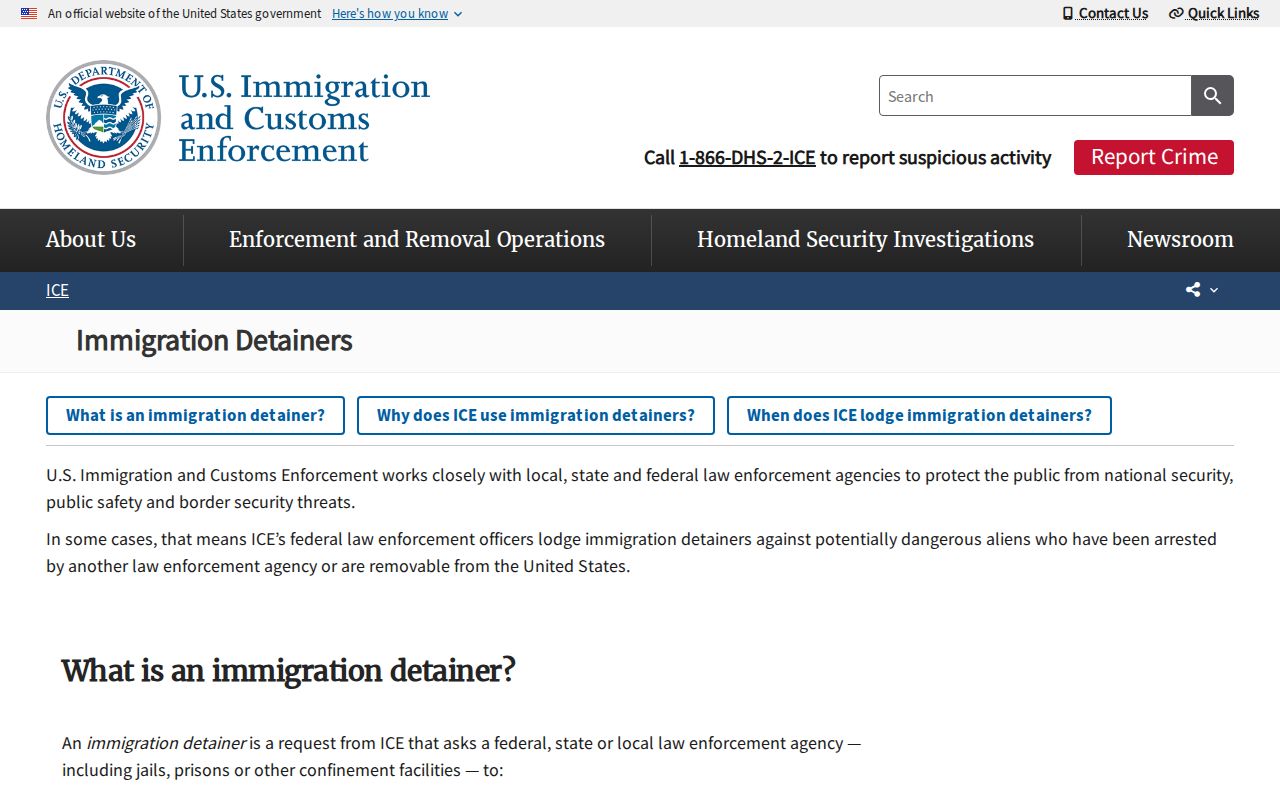
The source confirms why the end of a Uintah booking may be continued federal civil custody rather than a street release.
Note: No current Uintah ICE contract was confirmed, so every claimed transfer needs a case-specific destination record.
ICE Detention Release Records
ODLS is a status locator, not a permanent certified archive. Its recent-release coverage is limited, and a result can drop out after the published window. For an older event, use the person’s immigration case records, ICE records channels, counsel, or ERO as appropriate. Identify the person with an A-number and other precise details. Ask for an existing detention, transfer, or release record rather than a general account of the case.
If the inquiry began at Uintah County Jail, request the Sheriff’s existing local custody-event record separately. The county can document its own release or transfer date, recorded disposition, and receiving destination if maintained. It cannot certify what ICE did later. Conversely, ICE can address its own detention but does not replace the county record for the time the person left the jail.
- A-number
- An immigration identifier, commonly nine digits, used for a precise ODLS search.
- Detainer
- An ICE request for notice and brief continued custody so ICE can assume custody.
- ERO
- Enforcement and Removal Operations, the ICE component used for detention follow-up.
- Recent release
- An ODLS result within ICE’s limited post-custody display window.
Keep the two records in sequence: county exit or transfer first, then ICE detention or release.
ICE Release Search Limits
Several boundaries can explain an empty ODLS search. The person may be under 18, the name may not match exactly, the A-number may be incomplete, data may not yet have updated, the person may have left ICE custody outside the recent window, or the record may not be publicly displayed. The person may also be held by a different authority. None of those possibilities can be resolved by repeatedly searching a county roster that does not exist.
Contact ERO when exact identifiers still return no result. ICE’s detention and attorney information resources provide official navigation for case-related communication. Counsel may have routes that are not open to a general caller. Family members should keep the A-number and complete identity available. Do not publish sensitive identifiers while seeking help.
The official ICE detention resource was captured as a matched federal-immigration image.
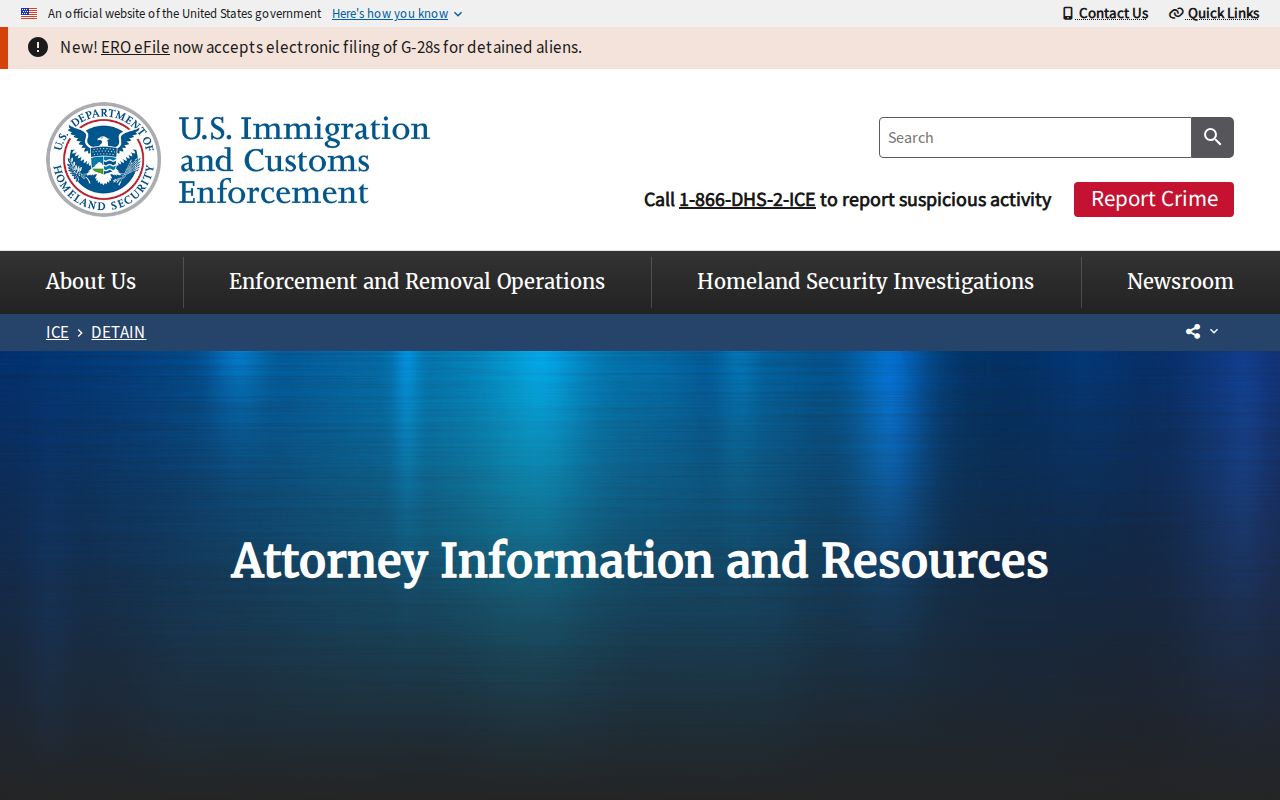
The page points the search toward authority-specific detention assistance when ODLS alone is incomplete.
ICE Detention Contact Route
No current ICE detention site was identified in Uintah County. Listing a local facility address or phone would therefore be unsupported. ODLS is the first public contact route. ERO is the fallback when the search does not locate the person. Attorneys should use ICE’s official attorney-resource pathway. If the person left Uintah County Jail, the jail remains the source for the initial receiving destination.
ICE Detention SystemFederal civil immigration custody
Online Detainee Locator System
ICE field office contacts
Do not send a county GRAMA request to ICE. County and federal access laws use different procedures. Ask the Uintah Sheriff only for the county-held release or transfer record. Use ICE’s records and case channels for what happened after federal civil custody began.
Note: Share an A-number only through appropriate official or legal channels, not in a public post.
Confirm an ICE Release
A sound conclusion should name the authority and event. “Transferred from Uintah County Jail to ICE” describes continued custody. “Located in ICE detention” describes current civil detention. “Released from ICE custody” describes the later federal event, subject to the exact ODLS or ICE record. Each statement is more useful than the vague word “released.”
Build a timeline with the county release or transfer date, receiving authority, ODLS status and search date, any facility move, and ICE release confirmation. If ODLS is blank, note the limitation and ERO follow-up. If a legal question affects access or case interpretation, use qualified counsel. The public locator cannot resolve every immigration proceeding.
The endpoint is not a guess about immigration status. It is an authority-specific record showing what Uintah County did and what ICE later reported. That distinction preserves accuracy even when the two events occur close together.